There's no such thing as a hard 4×4 Killer Sudoku
Shrinking Puzzle Lab's daily from 30 boards to 6 meant building a tiny Killer Sudoku — and measuring 16,000 of them showed the difficulty lever I rely on at 9×9 has nothing to push against at 4×4.
Puzzle Lab's daily had gotten out of hand. Three puzzle types, each with a full difficulty ladder, each at three grid sizes — 30 generated boards every night. Thirty leaderboards, most of them empty, because a small player base spread across thirty boards is nobody on any of them. A daily is supposed to be a ritual with a clear win condition, not a menu.
So the plan was to invert it: instead of publishing every combination, publish one board per puzzle type and let the difficulty be the thing that rolls each day. Three types today, so three standard boards plus three small ones. Six instead of thirty.
That plan has an obvious requirement hiding in it. If every type gets a small board, then every type needs to have a small board. Classic and Keisan already did. Killer Sudoku didn't — its minis stopped at 6×6.
Fine, I thought. The engine is size-generic. The exact solver already runs on 4-digit grids, the combination tables already ship a 4×4 set. This is a config entry, not an engine. Half a day, tops.
Measuring before building
I've been burned enough by "this should be easy" that I now spike before I commit. The spike was crude on purpose: generate a few thousand 4×4 Killer layouts across four different cage-shape configurations, keep the ones with a unique solution, and run each through the logical solver to find the minimum technique tier that cracks it. If the tiers spread out, I build three difficulties. If they don't, I find out now instead of after the UI is wired up.
Four configs, 4,000 attempts each. The result was not ambiguous:
| cage sizes | unique-solution rate | median 1-cell cages | tier 1 | tier 2 | tier 3 |
|---|---|---|---|---|---|
| 1–2 | 72.3% | 6 | 100% | 0% | 0% |
| 1–3 | 45.8% | 4 | 99.2% | 0.3% | 0.5% |
| 2–2 | 14.5% | 0 | 100% | 0% | 0% |
| 2–3 | 27.9% | 1 | 96.9% | 0.7% | 2.4% |
Tier 2 and tier 3 combined never cracked 3%, in any configuration. The difficulty scores clustered in a band so narrow — medians of 3 to 5, on a scale where a 9×9 expert scores 120+ — that "medium" and "hard" wouldn't have been distinguishable to a player even if I'd forced them out by rejection sampling.
Puzzle Lab grades Killer with a two-factor score (weighted technique frequency × opportunity density), and the 9×9 generator cuts its tiers at 42, 62 and 90. Put the 4×4's entire measured range on that same axis and the problem is hard to miss:

Every 4×4 layout I generated — across all four cage configurations — scores below 16. The 9×9 ladder doesn't even reach its easy cut until 42. There is no room down there to put three tiers.
Generation itself was fast and reliable — about 0.15 ms per puzzle. The problem wasn't that I couldn't make them. It's that they were all the same puzzle wearing different numbers.
I had a lever. I pulled it all the way. Nothing moved.
Here's the part I find genuinely interesting, and it's the third row of that table.
Killer Sudoku's difficulty levers are all about cage shape. The strongest by
far is the number of single-cell cages: a 1-cell cage with a 3 in the corner
isn't really a cage, it's a given wearing a disguise. My 9×9 ladder rides on
exactly this — easy gets a budget of 12 of them, medium 4, hard 1. Strip the
givens, force real deduction. That's the dial.
So at 4×4 I pulled the same dial to its stop. That's the 2–2 and 2–3 rows:
minimum cage size of two, meaning zero intentional single-cell cages.
The difficulty didn't move. Zero givens, still 100% tier-1.
Here's the generator doing it — eight consecutive rolls, alternating between the shipped easy config and layouts with every single-cell cage stripped out. The tier readout is the solver's actual grade, not a label I typed:
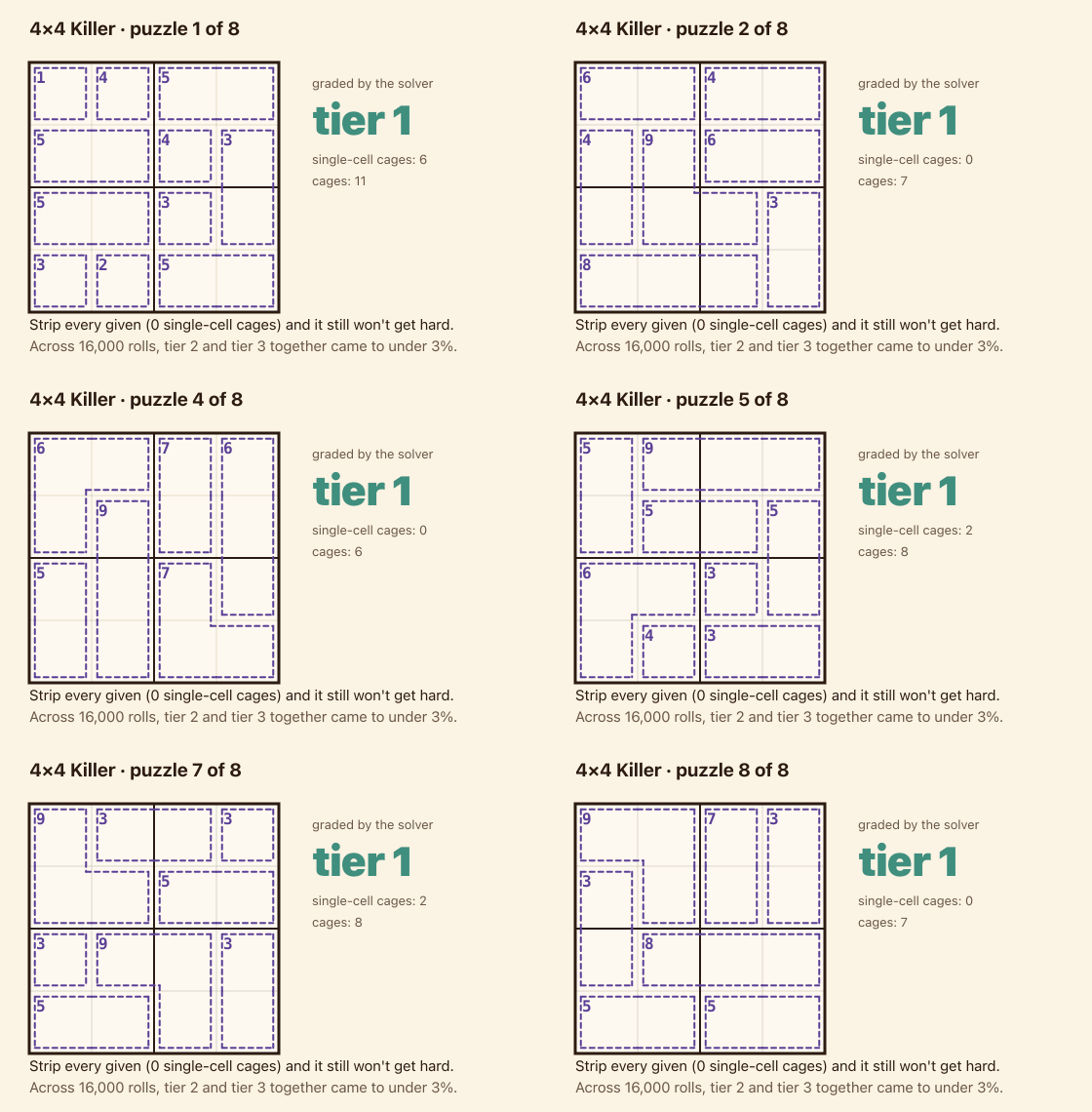
That's the finding. It isn't that Killer lacks a difficulty lever — it has one, and it's a good one. It's that at 4×4 the lever has nothing to push against. Sixteen cells and digits 1–4 leave so little arithmetic ambiguity that the sums alone collapse the grid to single-candidate logic no matter how you shape the cages. You can remove every crutch and the puzzle is still easy, because it was never the crutches making it easy.
Compare that to the two types that do keep three tiers at 4×4, and you can see
what they have that Killer doesn't. Classic grades by removing givens — and a
4×4 classic has sixteen cells of givens to play with, an actual budget. Keisan
(Calcudoku) grades substantially by its operator palette: its easy tier uses
only +, −, ÷, while medium and hard open up ×, which drags in
prime-factorization reasoning that genuinely changes how you think. Neither of
those levers depends on the grid being big.
Here's the same engine's output at both sizes — the 4×4 easy beside a 9×9 expert:

The expert board's cages sprawl across box boundaries with sums into the twenties — that's where the ambiguity lives, and that's what the hard techniques exist to resolve. The 4×4 simply has nowhere to put that.
Which, in hindsight, is the same story the 6×6 Killer ladder already told me — it stops at "hard," and the full five-tier ladder is 9×9-only. I'd read that as a tuning limit at the time. It wasn't. It was the shape of the thing.
What I actually built
Killer 4×4 ships with one difficulty: easy. That's the honest label, so that's the label.
The alternative was manufacturing a "medium" out of that sub-3% tier-2 band — slow rejection sampling to produce a puzzle barely distinguishable from easy, with a name that overpromises. That's a worse product than not having the tier.
The consequence landed in the daily's selection logic instead. The roller that picks each day's boards now carries an eligibility table, and it builds the day's assignment by enumerating every valid type-to-slot arrangement and choosing uniformly among those — rather than rolling first and retrying on failure. So Killer can take the easy 4×4 slot or any 6×6 slot, and it simply never gets offered the medium and hard 4×4 ones. A valid arrangement always exists, because Classic and Keisan cover the slots Killer can't. The constraint is satisfied by construction, not by retry.
The daily is six boards now. It rolls tonight for the first time.
The part I keep relearning
The reason I ran a throwaway spike instead of just writing the config is that the cost of being wrong was asymmetric. Building it first would have meant a generator, a registry entry, tests, and UI — and then discovering the tiers were fake, with a sunk cost quietly arguing for shipping a dishonest "hard" anyway.
Three hours of measurement turned a planned three-tier feature into a one-tier feature and made the surrounding system simpler, because "Killer is easy-only at 4×4" is a constraint the selection logic can be built around rather than a disappointment to paper over.
Difficulty needs a lever. Small grids starve the levers. That's worth knowing before you write the code, not after.